Archive for February, 2009

Taleb looks at the difficulties of learning about tomorrow’s failures

by henrycopeland
Friday, February 27th, 2009

Taleb writes:Go to a bookstore, and look at the business shelves: you will find plenty of books telling you how to make your first million, or your first quarter-billion, etc. You will not be likely to find a book on “how I failed in business and in life”—though the second type of advice is vastly more informational, and typically less charlatanic. Indeed, the only popular such finance book I found that was not quacky in nature—on how someone lost his fortune—was both self-published and out of print. Even in academia, there is little room for promotion by publishing negative results—though these, are vastly informational and less marred with statistical biases of the kind we call data snooping.

Pathetic pleading

by henrycopeland
Friday, February 27th, 2009

The hotel industry is begging Congress to not kill junkets.

NYT makes a funny

by henrycopeland
Friday, February 27th, 2009

NYT: “One leading European banker says a poll showed that the only groups now held in lower regard are prostitutes and convicted felons.”

Only $10 billion to go

by henrycopeland
Friday, February 27th, 2009

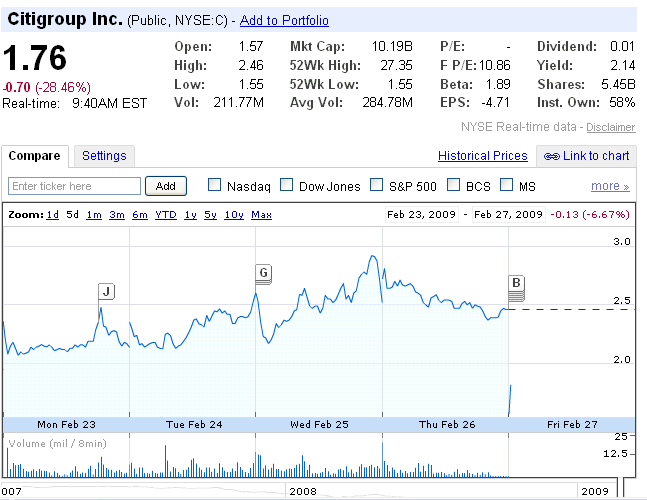
Only $10 billion in Citibank shareholder left to go. Will there be anything left at 4pm?

GDP plummets

by henrycopeland
Friday, February 27th, 2009

Bloomberg:

The U.S. economy shrank in the fourth quarter at an even faster pace than previously estimated as consumer spending plunged, companies cut inventories and exports sank.

Gross domestic product contracted at a 6.2 percent annual pace from October through December, more than economists anticipated and the most since 1982, according to revised figures from the Commerce Department today in Washington. Consumer spending, which comprises about 70 percent of the economy, declined at the fastest pace in almost three decades.

The recession is forecast to persist at least through the first half of this year as job losses mount and purchases plummet. The Obama administration’s attempts to break the grip of the worst financial crisis in 70 years are unlikely to bring immediate relief as companies from General Motors Corp. to JPMorgan Chase & Co. cut payrolls.

“The economy really hit the brakes very hard in the fourth quarter,” John Herrmann, president of Herrmann Forecasting LLC in Summit, New Jersey, said before the report. “We’re in a pretty severe, protracted recession. The economy could continue to struggle into 2010.”

GDP was projected to contract at a 5.4 percent annual pace last quarter, according to the median estimate of 74 economists surveyed by Bloomberg News. Forecasts ranged from declines of 3.8 percent to 6 percent.

The 2.4 percentage-point revision was almost five times as large as the average adjustment, Commerce said.

Twin peaks

by henrycopeland
Friday, February 27th, 2009

Think getting out of this mess is going to be easy or painless? After hearing this NPR story this AM driving to work, Obama’s face on the “Hope” sticker on the car in front of me just looked pained and sad.

David Beim, a former banker who is now a professor at the Columbia Business School, has something to say for people who want to pin this whole thing on the banks.

He has a chart illustrating how much debt American citizens owe, how much we all owe — with our mortgages and credit cards — compared to the economy as a whole. For most of American history, that consumer debt level represented less than 50 percent of the total U.S. economy, as measured by gross domestic product.

And then …

“From 2000 to 2008, it’s almost a hockey stick. It just goes dramatically upward,” Beim says. “It hits 100 percent of GDP. That is to say, currently, consumers owe $13 trillion when GDP is $13 trillion. That is a ton.”

This has happened before. The chart shows two peaks when consumer debt levels equaled the GDP: One occurred in 2007, the other in 1929.

And that scares Beim.

“That chart is the most striking piece of evidence that I have that what is happening to us is something that goes way beyond toxic assets in banks. It’s something that has little to do with the mechanics of mortgage securitization, or ethics on Wall Street, or anything else,” Beim says. “It says: The problem is us. The problem is not the banks, greedy though they may be, overpaid though they may be. The problem is us.”

Gold bugs will no doubt remember that one of the key tools for jacking us out of the Depression ditch was devaluing the dollar 40% in 1933 when FDR took the country off the gold standard. Here’s a video with newsreel footage from that period. And here are a couple of charts of US private indebtedness over the last 100 years.And here’s our hope.

CDOs and other oddities

by henrycopeland
Friday, February 27th, 2009

Michael Lewis weaves another wonderful narrative explaining another sordid, smelly corner of the meltdown:

That’s when Eisman finally got it. Here he’d been making these side bets with Goldman Sachs and Deutsche Bank on the fate of the BBB tranche without fully understanding why those firms were so eager to make the bets. Now he saw. There weren’t enough Americans with shitty credit taking out loans to satisfy investors’ appetite for the end product. The firms used Eisman’s bet to synthesize more of them. Here, then, was the difference between fantasy finance and fantasy football: When a fantasy player drafts Peyton Manning, he doesn’t create a second Peyton Manning to inflate the league’s stats. But when Eisman bought a credit-default swap, he enabled Deutsche Bank to create another bond identical in every respect but one to the original. The only difference was that there was no actual homebuyer or borrower. The only assets backing the bonds were the side bets Eisman and others made with firms like Goldman Sachs. Eisman, in effect, was paying to Goldman the interest on a subprime mortgage. In fact, there was no mortgage at all. “They weren’t satisfied getting lots of unqualified borrowers to borrow money to buy a house they couldn’t afford,” Eisman says. “They were creating them out of whole cloth. One hundred times over! That’s why the losses are so much greater than the loans. But that’s when I realized they needed us to keep the machine running. I was like, This is allowed?”

Initial employment claims

by henrycopeland
Thursday, February 26th, 2009

Keep climbing.

In the week ending Feb. 21, the advance figure for seasonally adjusted initial claims was 667,000, an increase of 36,000 from the previous week’s revised figure of 631,000. The 4-week moving average was 639,000, an increase of 19,000 from the previous week’s revised average of 620,000.

Bottom of the barrel?

by henrycopeland
Tuesday, February 24th, 2009

Social media entrepreneur Jason Calacanis says the market has bottomed, as he’d predicted.

UST Ponzi

by henrycopeland
Monday, February 23rd, 2009

Floyd Norris reports:

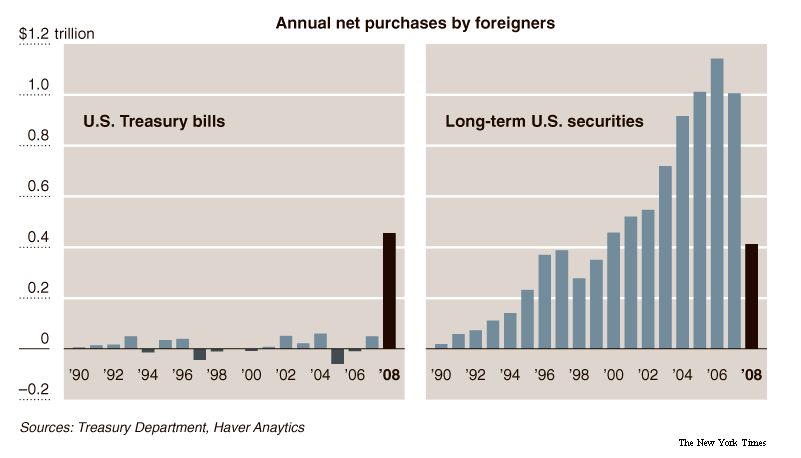
The government said this week that net purchases of [long term] securities fell to $412.5 billion in 2008, less than half the 2007 level and the lowest annual total since 1999, when the federal government was running a budget surplus.

Money did come in, but it was diverted into the safest investment around, albeit one with almost no expectation of profit, Treasury bills. Overseas investors increased their holdings of those securities by $456 billion, an unprecedented flow.

Relying on foreign investors to fund our deficit is not unlike running a Ponzi scheme. It’s fine as long as new money comes in, but when the money flow stops, we’re effed. As the chart below shows, we’re now addicted to foreigners’ short term financing.

Welcome to Facebook

by henrycopeland
Saturday, February 21st, 2009

A friend in San Francisco, a graduate of Harvard Business School and former Jack Welch protege, writes: “Dude, you would be proud of me — I even got on facebook last week….twitter next?” I respond:

Dear Arpad,

Speaking of technological advances, you might also want to have one of your cleverer butlers investigate these new portable telephonic devices. I’m unsure about the advisability of walking and talking at the same time, but potentially an uncorded telephone could be useful when one needs to
visit the toilet.

Or perhaps one could just purchase a longer telephone cord? (Note to personal secretary: Monday cable Bear Stearns, instructing them to buy on our behalf 1000 shares in our nation’s biggest wire manufacturer, Consolidated Brass Tacks and Tarpaper, at a price limit of 11 & 3/8ths. That was the price last April and I assume it has not moved since.)

Now, Aprad, I hope you are sitting down because I have to share something else shocking. I don’t know what the newspapers in The West are writing about, but here in North Carolina, some crazed journalists predict that one might, some day in the distant future, convey short textual information
through these mobile telephonic devices (”teles?”).

I think THAT is clearly absurd. Man will sooner walk on the moon than type correspondences into a telephone. For one thing, how could this typing be achieved with a rotary enumerator? And what would decipher the text and translate it back into speech so it can be comprehended? The mind boggles. Finally, and most importantly, even if all this flapadoodle were possible from the standpoint of the engineering gents, it seems clear to me that such information as shopping lists, theatrical scripts, marriage proposals and business propositions should ONLY be composed at leisure using pen and ink. Why would one rush to create or convey such information? Clearly great harm could come from ill-considered missives composed when one is in one’s cups and reposed on the toilet.

Yes, the mind boggles.

I hope you and your family remain in good health, and I remain, as ever, your friend in anachronism…

Mr. Copeland

Skedaddle

by henrycopeland
Saturday, February 21st, 2009

Two other blog advertising competitors bow out without so much as a whimper:

Back when the election season first started I joined MSNBC Politics advertising network. They promised fifty five cents per one thousand impressions and they delivered. As soon as the election was over they quit advertising on my site without explanation. I finally contacted them and they gave a poor explanation that their company was going in a different direction now that the political season was over. I also joined the Buzzlogic advertising network in their beta period. They promised two dollars per one thousand impressions and they delivered as well, until this month. I basically got the same explanation as I got from MSNBC’s network. They won’t be advertising with us in the near future.

Gold busts $1000

by henrycopeland
Friday, February 20th, 2009

Worth writing about only because it will be headlines of tomorrow’s NYTimes biz section.

This will be below the headline about Citibank being put out of its misery by the government, of course.

How big a pile?

by henrycopeland
Friday, February 20th, 2009

The world’s biggest mutual fund, PIMCO’s Total Return fund, has $132 billion in assets. The fund has been gaining new fans based on its conservative management and steady returns as other mutual funds tanked.

PIMCO is a great reference point for understanding just how scarce gold is, relative to the pool of money that might be scrambling for some ballast amid today’s financial hurricanes.

The ~1000 tons of gold held in the SPDR GLD fund, a gold-backed security that currently constitutes the world’s seventh largest stockpile of gold, are worth only $23 billion.

From Wikipedia.

Crystal ball

by henrycopeland
Friday, February 20th, 2009

You know “social media marketing” (so-me-marcom?) is totally mainstream when a fortune teller, being interviewed by NPR about how the recession is helping her business, mentions that she uses her twitter account for “customer retention” and the journalist doesn’t make that the point of the story.

At 8:09 Eastern, said seer, Alexandra Chauran aka /earthshod, has 276 followers.

Next to last tweet: “My fortune cookie: “A blonde from afar has something interesting for you.” WTF to DEATH with that cookie?”

OK, I’m following her.

It’ll be an interesting test of the twitter/NPR/so-me-marcom nexus to check, at the end of the day, how many radio listeners have followed her.

Playing so-me-marcom-seer myself, I’ll predict >500, with a good chance Alexandra meets an enriching new life-partner if she’s remains vigilant to the day’s wonderful potential. (And she’ll rival Scoble a few months out if the twitteroi adopt her as The Official Twitter Sage.)

Social media consulting bubble

by henrycopeland
Thursday, February 19th, 2009

BL Ochman, auteur of Budget Rentacar’s great social media campaign , makes an fun observation about the glut of instant experts on social media marketing:

• 4,273 Internet marketers

• 1,652 social media marketers

• 513 social media consultants

• 272 social media strategists

• 180 social media experts

• 98 social media gurus

• 58 Internet marketing gurus

How many of them have actually created a successful campaign for clients using social media tools? I bet you'd be hard-pressed to find half a dozen with real track records.

GDP fantasy?

by henrycopeland
Thursday, February 19th, 2009

The board members of the Federal Reserve are becoming more pessimistic about the economy. Bloomberg reports:

Fed officials, at their policy meeting in late January, said the economy would contract between 0.5% and 1.3% this year, far worse than their October projections spanning between a 0.2% decline and 1.1% expansion. The figures exclude the three highest and lowest forecasts of the Fed’s 16 sitting policy makers at the time. If all projections are included, the output forecast ranges from a decline of 2.5% to a gain of 0.2%.

The odd thing about these projections, or those of most private economists, is that they are an order of magnitude less severe than any numbers that real businesses are experiencing at present. (For that matter, last year’s numbers are suspciously mild, with GDP contracting 4.3% in the second half of ‘08.)

Car sales are down 30-40% year over year. Housing construction is off 17% versus a year ago. Layoffs each week have doubled versus a year ago. Many retailers are seeing 10-20% contraction in sales. Industrial production dropped 1.7% last month alone. (Off nearly 12% in the last year.)

Virtually the only big name companies that are reporting ANY significant growth are Walmart (+2.8% year over year), McDonalds (+5.4% year over year) and Google (growing 3% a quarter?) The only segments, overall, that are reporting employment growth, very moderate, are education, government and healthcare.

What’s missing? Are we going to see massive downward revisions?

Gold a go go

by henrycopeland
Thursday, February 19th, 2009

Without any great fanfare, gold is poised to break above $1000/ounce, right now at $986 after a steady drift upward this week. Maybe we’ll come in tomorrow AM and see new highs.

According to Bloomberg, The SPDR Gold Trust, a gold backed security, is now the seventh-largest holder of gold, after the International Monetary Fund and the governments of the U.S., Germany, France, Italy and Switzerland. As of yesterday that security had 1,008.8 metric tons. The unabating hunger for gold among currency-fearing investors is going to push SPDR holdings steadily up in the league tables of gold holdings, so that SDPRs now account of more gold than the reserves of the Central Banks of Japan and the UK put together.

$1000 is a big psychological hurdle and surpassing it will undoubtedly spark some headlines — maybe the cover of Business Week with a headline “How High Gold?” — but the historic high in dollars is $1030, reached last July. (Gold’s explosion won’t be over until Business Week’s headline is “Gold Back to the Future: next stop $3000?”)

More important than the $1000 hurdle, it’s important to know that gold is at unprecedented levels versus the Euro and Sterling, two currencies that being sucked into a whirlpool of capital flight.


[Most Recent Quotes from www.kitco.com]

What’s interesting about watching gold trade is that, historically, gold’s fan base is mostly freaks and black helicopter paranoids. “Gold bugs” are usually déclassé, moonshine and trailer parks to Wall Street’s Dom Perignon and Park Avenue. Once every hundred years, the crazy folks are right.

Glut ad infinitum

by henrycopeland
Wednesday, February 18th, 2009

Martin Peers, in the the Wall Street Journal, picks up the thread on the glut of potential ad space with this great lede:

What does the Internet display-ad market have in common with Zimbabwe?

Both are printing nearly-limitless amounts of their main currency, vastly diminishing its value and undermining their future. The currency, for Web sites, is their ad inventory. And while Zimbabwe, under different management, can change course, the same isn’t true of the display-ad market. Web sites keep generating new content and extra pages on which ads can run.

More thoughts on the advertising inventory glut here.

PBS meltdown coverage

by henrycopeland
Wednesday, February 18th, 2009

I want to remember to watch this later…

Truffles a la mode

by henrycopeland
Wednesday, February 18th, 2009

Some of the best reporting in the NYT has been the micro-histories by life-style reporters. Today’s story about the upper East Side restaurant Sette Mezzo is another great snapshot. The restaurant, which serves $40 for pasta and $30 for salad and water, is the family canteen for the likes of Si and Donald Newhouse, Tom Tisch, Jonathan Tisch, William Lauder, Saul Steinberg, George Soros, Lily Safra, Leon Black, Michael Schulhof, Mike Nichols, Donald Marron. Cash only. (Or you can throw it on your monthly tab.)

Even here, though, the recession’s cool breeze is blowing.

starting in November, when fresh black truffles arrive, they can be added to any item at $50 for the first flurry of shavings (subsequent shavings are discounted). White truffles bring any entree price up to $200. “I always cover the top,” Mr. Mania said, adding that at a certain other Italian restaurant, “they give you three slices.”

Not that there have been many takers lately. “Nobody ordered truffles this year,” Mr. Esposito added. “It must be the economy.”

NYT butts into the conversation

by henrycopeland
Wednesday, February 18th, 2009

I was wrong to that the Times isn’t conversing. Here’s some chat-back from another NY institution, the 92nd Street Y Tribeca. (Thank you Ken!)

The end of the Euro

by henrycopeland
Tuesday, February 17th, 2009

The Germans are going to step in and backstop all Europe’s sloppiest economies. Imagine being a prudent budgeteer who is forced to pool a family budget with 20 of your neighbors, but having no voice in how they spend their money. How quickly do you think the credit card debt would add up?

German Finance Minister Peer Steinbrueck said euro-region countries may be forced to bail out other members of the 16-nation bloc that face problems refinancing their debt.

“Some countries are slowly getting into difficulties with their payments,” Steinbrueck said late yesterday in a speech in Dusseldorf. “The euro-region treaties don’t foresee any help for insolvent countries, but in reality the other states would have to rescue those running into difficulty.”

While declining to identify countries facing problems, the German finance chief said Ireland, which has a widening budget deficit, is in a “very difficult situation.” Ireland’s debt- rating outlook was cut by Moody’s Investors Service Jan. 30.

TV and depression

by henrycopeland
Tuesday, February 17th, 2009

Beware to boobtube:

Brian Primack, a pediatrician at the University of Pittsburgh School of Medicine who studies how teenagers’ use of media affects their health, analyzed survey data that followed 4,142 teenagers from 1995 to 2002. Teenagers who watched TV were more likely to report symptoms of depression, with the rate increasing 8 percent with every hour of TV watched.

Neil Postman’s “Amusing ourselves to death” was truer than he knew.

Since the Great Depression

by henrycopeland
Monday, February 16th, 2009

Usage of the term “since the great depression” among documents indexed on Google, now clocking in at 5,600,000, is up almost 10-fold since September.

We’ve got 90,400 instances of “worst since the Great Depression” and 9,160 instances of “longest since the Great Depression.” But zero instances of “weirdest since the Great Depression.” Until now, of course.

NYTimes’ pathetic cab ad

by henrycopeland
Monday, February 16th, 2009

Reading James Surowiecki’s sneer about NYT’s bathetic advertising of its own product reminded me that I’d recently taken note of NYTimes ad running in the TV screen the back of my cab.

What unnerved me the most was the Times ad’s emphasis on “conversation”… “center of the conversation”… “get the conversation going”… and “be part of a great conversation.” All these phrases were uttered by hip-ish looking 20 and 30-somethings.

Clearly, the Times is desperately hoping to stay relevant to the under-sixty-year-olds who are turning their collective back on the Times, even as they consume and create giant new volumes of their own media (aka conversation.)

Advertising its ersatz conversations, the Times’ resembles a Baptist church trying to compete for the hearts and minds of indie rock fans by running ads declaring “hey, we’ve got great music too!”

Cultural attention deficit disorder, etc, etc

by henrycopeland
Monday, February 16th, 2009

In this month’s Atlantic, Michael Hirschorn does a great job of summing up the challenge for television networks.

On the “buy side,” the problem is what I’d call cultural attention-deficit disorder, which afflicts the consumer bombarded with choices: more TV networks (the Emmy Award–winning show Mad Men is broadcast on AMC, a channel previously known only for showing movies), more video games, more Web sites, and more ways to consume shows than ever before (VOD, DVD, PPV, etc., etc.). And all of this is compounded by the loss of the social effect: the fewer people who consume any given piece of media, the fewer people there are to tell you how awesome The Life & Times of Tim is and how you simply have to watch it. Amid the chaos, it’s difficult for a media consumer to care enough about any one thing to stick with it—and for a network trying to build allegiance to a brand, convincing anyone that what you’re showing matters becomes almost impossible.

I’ll continue to argue (as I’ve been doing since ‘02) that blogs, as communities that create and consume news and opinion together, are uniquely positioned in this exploding universe as one of the few media players with centripetal force.

Shiller’s overview of real estate

by henrycopeland
Monday, February 16th, 2009

Robert Shiller, the great real estate bear, lectures…

Dominoes as big as Alps

by henrycopeland
Monday, February 16th, 2009

Ever hysterically rational, Ambrose Evans-Pritchard writes this morning about European banks’ huge lending overhang to post Communist economies. The headline, “Failure to save East Europe will lead to worldwide meltdown,” seems to suggest there’s some alternative to failure. Sadly, Europe doesn’t have the capital, political will OR the political infrastructure to rescue either the west European banks or East European folks who have borrowed absurd amounts of money valued in other countries’ potentially much stronger currencies.

Grey lady goes dark?

by henrycopeland
Friday, February 13th, 2009